
Content writing is not rocket science. Until you realize it doesn’t work the way you want it.
That’s when most non-writers or inexperienced writers start to question the value of content as well as how Google chooses one blog post over another.
But let me tell you this:
There are no secrets when it comes to writing memorable content.
Just a lot of [and I mean way too many] things to pay attention to.
That’s exactly what I’m here to bring to light. 😉
Why I created this content writing guide?
The purpose of this guide is to help startups understand the value behind content and how they can get started with writing articles from day one. The next chapters will take you through all the steps and tips you need to know before writing any content.
This is NOT a content marketing guide. Content marketing is a more complex field that involves both writing and promoting your content along with other adjacent methods. It would take an entire book with multiple editions to write that. I’ve tried to keep the guide on-point so you can go through it even if you’re busy.
Let’s get to writing!
Understanding WHY you need content
I’ll be honest with you, you don’t always need content from the start in a non-competitive industry.
Content comes in when you’re looking to differentiate your brand, gain exposure, or move towards the next step. Yet, there’s no content marketer who will say that content is useless because there are thousands of business goals you can fulfill by writing great content.
Here’s a run through some of these benefits:
- Increase your website’s traffic
- Improve your search engine rankings
- Gain leads and have them bring new customers
- Grow your conversions
- Strengthen your position in the industry
- Become a subject matter expert and gain the trust of your leads
- Create brand awareness
- Loyalize and delight customers
- Engage with prospects and existing customers
- Become an educator and dependable source for insights and reports
- Recruit new talent to help with your employee branding efforts
- Improve your brand’s reputation
- Reduce the costs you’d attribute to paid advertising efforts
- Build partnerships and promote your collaborators
- Create a community and gain new insights into your market
- Make a difference for a cause your support
- Appeal to all buyer funnel requirements
- Stay top-of-mind
- Promote diversity
- Give your team a chance to voice their opinions and knowledge
- Keep people coming back to your website
By far the biggest mistakes most new or upcoming businesses make is assuming they’ll be able to do well without content.
Truth is, content along with solid industry partnerships are the only two tactics that will keep your business thriving in the long run. Other marketing attempts like paid advertising or promoted posts only provide temporary results you might not afford.
The easiest way for me to convince you that content is worth it is to have you look at your top 3 competitors. If they’re taking content to the next level, it’s time for you to consider it too. To give you an example, in the SaaS industry all #1 products from each category have become a go-to source when someone needs solid info on a topic.
When to get started with content writing
One thing to clarify is that content is not just on your blog. Many startups opt for a social media or video marketing strategy at the beginning. Others create their own communities well before launching a product. This is a good choice if you want to get more insights into your prospects by being exactly where they are and learning to speak their language.
When it comes to articles, there’s a decision startup owners have to make between hosting their blog and writing content on Medium or as guest posts. Any option is better than having no content.
Yet, here’s a go-to formula you can approach without hesitation:
- Start your blog [as a subdirectory, please] and don’t waste months trying to get the perfect structure for it
- Write articles based on your content strategy and editorial calendar
- Launch a Medium blog to republish content according to the best practices I’ve previously explained
- Craft a content promotion strategy that will include guest posting and promoted articles
Why does everyone’s content look the same?
Anyone who’s ever searched for a guide on any topic might have noticed a similarity between the first results.
Two situations here:
- Writers don’t spend enough time on an article either because they can’t be bothered or they have a strict deadline. ← This is BAD
- By researching the SERP (search engine results page), you’ll notice the top 10 articles have similar headings and topics they cover. This is because for every single keyword there’s a separate reader’s intent. In other words, writers need to provide the exact information that readers are looking for. To make articles easier to skim [and for bot crawling purposes], all ideas are placed under similar headings that are often the same due to the keywords they target. ← This is partially GOOD
If the goal is to rank, unfortunately, most content writers have no choice but to be Google’s slaves and comply with their algorithm requirements and changes.
🤦♀️
So how can you make your content stand out?
The concept of writing unique content is as varied as the multiple approaches you can pursue.
Let’s take the possibilities one by one.
Turning to your network
All the round-ups and posts where experts share their thoughts as you’ve seen everywhere have a purpose: to make use of other people’s expertise and gain initial post traction through their shares. Plus, let’s be honest, most of the articles you see on news and media outlets include quotes to make sure the article is not subjective.
While a round-up post is often not an evergreen solution to your content problems, incorporating the insights of other top professionals helps improve credibility and showcase a multitude of points of view.
But wait… how do you get those quotes?
Here’s where it pays to have a solid network like a lot of LinkedIn connections you keep in touch with or your own Slack community. For faster results, there are Facebook groups, Slack communities as well as PR tools like HARO or SourceBottle. And of course, you can always turn to your own team, partners, and even clients.
Reports and surveys
When all else fails, having regular reports that others can use and reference is a huge PR move. A top-of-the-mind example is Buffer’s yearly report on the State of Remote Work. Frankly, when someone writes an article on remote work, they’re likely to mention at least one of their findings.
For a startup with a limited budget though, running a survey for several months is nearly impossible. You won’t be able to afford to pay for someone to run this research, getting all the tools, and even paying for a market research company to provide you with the necessary sources.
That’s when you rely on your own capabilities.
The email marketing zone is pretty strong on that. ConvertKit runs a monthly reporting series on email deliverability to share insights they have from their own tool. Similarly, here are some statistics on the best time to send an email as concluded by the MailerLite team.
As an independent writer, I don’t have access to such data most of the time. And you might not have a software or service backed with thousands of data entries to make use of either. So I now do my own research and put together my own reporting as often as possible.
In this remote product management career guide for instance, I analyzed 100+ remote product manager jobs from Glassdoor to see what the top required skills are.

In-depth research
Take my guide to writing an article introduction. I ran through all possible situations of starting an article and backed them all up with explanations and several examples. Definitely different from the other articles on the same topic that give out the tips.
Or this article with 110 landing page examples from Instapage. Yes, they have 110 examples and all of them are detailed. Here’s what the engagement on the post looks like:
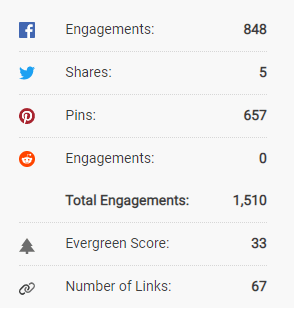
Google “landing page examples” to see more cases like these that will blow your mind.
Most of these also rank for the “landing page” keyword—one of the few terms out there that has a double reader’s intent. This means people want to get both examples and insights into what landing pages are and best practices for creating them. The Instapage article above nails that by giving out the examples followed by detailed explanations.
Your own opinions and knowledge
Now here’s a headline everyone will want to read:

The article is an account of a person’s experience. And nobody can say more about what you’ve achieved than you.
So here’s your approach: tackling a topic using your own expertise and opinions. See YouTube for extra inspiration:
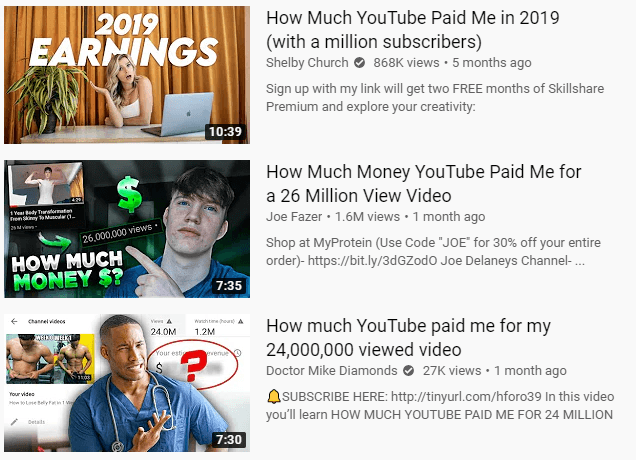
Things aren’t as simple though. You can’t rank for “landing page” if you say that landing pages are useful but don’t meet the reader’s intent. Some topics do leave out so much room for you to present either a mix of opinions or your point of view alone. Like what I did here where 50+ other articles on the same theme were repeating a similar viewpoint.
Controversial posts
We’ve all had them.
It’s posts like “We’re Not On Facebook Anymore” or “Why We’re Not Using Google Analytics”.
See this example on quitting Twitter.
For startups, this approach works when you’re publishing something on a high-authority media or news website. Once you start getting a solid readership, similar announcements can be used on your blog too to bring more curious eyes over your owned website. Do make sure to back up all your claims.
Tackling an entirely different topic
This is super difficult.
Most things have already been written at some point in one form or another. What you can do is bring a topic that’s not related to your industry or what you usually write about and connect it to what’s relevant. Like this post on what marketers can learn from movies.
Another tactic here is to be the first one to write on a topic ahead of the others. While this is indeed time-draining, it has huge results because if you’re putting a great piece together you have the chance of becoming a top resource, strengthening your expertise, and bringing in backlinks to your website.
I like using Google Trends and Exploding Topics to find upcoming trends and potential topics before others.
Truth is that the first people who are going to write about a topic will usually have a better chance of writing effective content.
This takes us to…
Coming up with ideas
Content topics don’t always come to you. Matter of fact, you’re better off sticking with the subjects you’ve researched beforehand. Those articles or guides you’ve been planning to write for a while now.
That’s exactly why you’ll need a professional content strategist to put together your editorial calendar. Simply put, a content strategist makes use of all available networks and resources to craft the content plan. From seeing what people are talking about on social media to using specialized tools, doing competitors research, and analyzing the best possible ranking opportunities.
Personally, I’m a super big fan of spontaneous content. To be honest though, this is okay only AFTER you’ve started to create a solid audience. Newsletters, for instance, are a perfect opportunity for you to showcase any impromptu thoughts and concepts. Or, you can use a Slack community to bring a new topic of discussion every day.
The thing is Google does rank your website higher after you have a couple of articles to show your expertise on a topic. As an example, imagine you’re running a branding agency. Your “Ultimate Guide To Branding” won’t rank as well if it’s your first article than if you had 20 previous articles to back up your expertise.
For this reason, consider your permission to start writing content right away granted. Do, however, keep in mind you should always write on topics related to your business and make sure you put in all of the best practices from this guide.

Now…
Let’s assume you’ve got your ideas in check and you finally have time to write.
Finding search intent before writing content
Unless you’re opening a text editor and hitting publish after 800 words, you’re most likely doing SERP research in one way or another.
Proper research of a topic includes:
- Analyzing the ranking opportunities for specific keywords
- Finding trends
- Choosing a keyword
- Discovering more about what people are saying on that topic
- Having a super uber extra detailed look at the first results that Google shows you for your main keyword of choice
But here’s something to dwell on: when the first 10 articles are the same, you need to cling onto an idea that will make your article stand out. That’s when you start looking beyond the top 10 to see what other ideas were shared and, above all, what nobody else mentioned.
A large part of how Google judges your content is dedicated to the reader. All in all, if readers spend more time on your article, prefer to link to your post, or return to your content over other competing pieces, your article will be placed higher.
If you’re trying to rank for “working from home” and you’re going to be presenting tools only instead of tips and a thorough guide to working from home [this is the reader’s intent for this keyword], your article might fall out of top 100. That’s like not ranking at all.
Reader intent is diverse and really does depend on the keyword.
Here are a few cases to take into account when writing:
- Looking for a quick answer: “weather + city”
- Transactional purposes: “gaming laptops”
- Local intent: “coffee shops around + city”
- Needing a definition: “what is fulfillment”
- Instructional: “how to clean your keyboard“
- Expecting a list of options: “VPN services”
- Even simple image search: “blue flowers”
Most articles though are a mix of the above.
You’ll rarely see an article that gives a definition and ends there. Certain keywords have multiple reader intentions. Like “product manager job”:
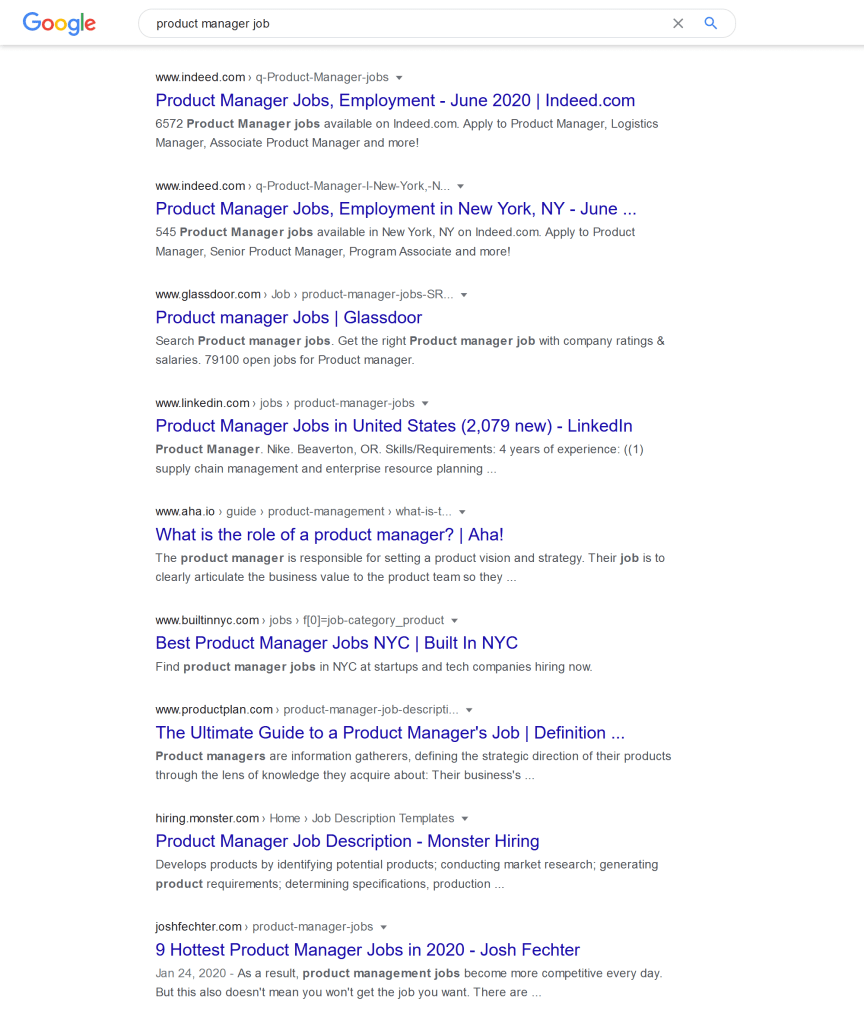
Here, people could be looking either for jobs or help with getting started with a product management career.
A wrong presumption would be to assume that the same person searches for both of these results. There’s a slight difference between people who are still debating whether this is the right career for them and those who are already looking for a job in the field.
What’s the whole deal around personas?
The secret here is not to create content based on simple demographics.
For instance, take the following situation:
You have a general social media planner tool you want to create brand awareness for. Your ideal customers include all kinds of marketers.
What’s the one mistake here?
⏳⏳⌛️
Your target market is too broad.
Not any marketer is going to buy your tool. There are teams with 2-5-10 marketers where only one of them makes the final decision. That marketing manager who “has the money” and will choose or change the tech stack is whom you should write for.

So who are you writing for?
There’s no such thing as a general article that’s written for everyone.
I know. This is the single thing about writing content I don’t like either. 😓
Let’s take a common case I always bump into: the “remote work tips” keyword.
Are these tips for employers?
Are they for workers?
A quick search and the results are mixed:
- 13 Tips and Tricks for Working Remotely
- 23 Essential Tips for Working Remotely
- 11 Essential Tips for Effectively Managing Remote Employees
- 5 Tips for Staying Productive While You’re Working From Home
These results from the top 10 do have one thing in common: they’re not written for both audiences. They have A SINGLE buyer persona in mind.
Like this, “email marketing guide” will target up-and-coming marketers. “Design trends” is something creatives would be interested in. And “succulent plants” is for anyone who’s looking for the basics, from general info to shopping for a new succulent.
These examples above are perfect for helping you understand that the person you’re writing for doesn’t really have a single characteristic. An article on “design trends” will target UX designers, UI experts, illustrators, video makers, and all kinds of creative professionals regardless of their experience, location, or secondary interests.
But you do need to nail their lingo.
Speak like them and speak to them only. Don’t switch your tone and person from talking to a manager in one paragraph and then to employees in another. Consistency is the key concept to remember here.
And wait, web browsers are all from different locations so they all have different needs. An acronym or concept can mean entirely different things to every culture.
FUN TIP
Use SERPROBOT to check the exact intent for specific locations. The tool renders unbiased results that don’t take into account an individual user’s past searches and preferences.
Formats and more formats
As you’re looking for the reader’s intent, you’ll notice patterns in terms of the format of those posts.
They could all be guides, lists, or just news articles.
While you can rank a guide among multiple lists, if the reader’s intent is aimed at getting the latest news, there’s no way a simple list of tips will make it.
Here’s a huge list of formats to pay attention to:
- Lists and nothing more
- The guide that eventually includes a bunch of lists
- Questions and answers
- Expert round-up posts with lots of quotes
- Case studies
- Interviews
- Comparison posts
- Reviews for anything
- News, feature updates, launches, partnerships, and everything that’s related to what your company does and what you sell
- Simple opinion posts
- News
- The apparent article that’s really a podcast or transcription of a video
- Viral personal stories
- The survey results
- E-books
- The article that’s 90% an infographic
- Event summaries
- Curated lists of other resources and articles
Using past results – time for fun analytics!
The content you write needs to be tweaked as you go.
If your audience doesn’t like a serious tone, switch it.
Not seeing engagement with listicles? Opt for a different format.
You can see all this in your Google Analytics and Search Console data [or if you use a similar tool]. Any SEO tool in fact will show you what your top pages are, who your audience is, where readers come from, and so much more.
For Google Analytics, you’ll want to spend a lot of time in the Behaviour section:

The stats to keep in an eye on here are:
- Behaviour Flow – this tells you how readers move from one article to another
- Landing Pages – sort these according to the date range you want to analyze or compare to another
- All Pages – I tend to prefer checking this over landing pages since it gives you a full look
- Exit Pages – when paired with a short time on site it shows you which articles or pages didn’t meet the reader’s needs
- Site Search – if you have a search option on your website, it can show you exactly why people are there and what their top interests are
USEFUL TIP
Always add secondary dimensions to get more insights from a single view. Here’s a brief guide.
I check these daily but I’m obsessed with data so don’t mind me. 😂 A quick check every other week should be enough for most content writers.
Incorporating storytelling into your content
The idea behind storytelling in articles is that readers don’t want to see mechanical writing.
They’d much rather trust someone’s personal experience or research of other people’s experience than general statements.
That’s why, beyond successful posts like “How I Grew My Business By X% In A Year” or “How I Managed To Avoid Burnout”, round posts such as “50 CEOs Share Their Best Life Advice” are huge traffic catchers.
You don’t need to turn to fiction to be a good storyteller.
So how do you improve your storytelling skills?
Four steps:
- Stick to your audience by using their language consistently.
- Start by presenting a problem your target readers commonly deal with.
- Gradually offer one or more solutions to their problems.
- Show them how your product can fix their problems.
The actual content writing process
I’ve always been against telling someone how to write, what to focus on, or what words to use. Every person has a different style of writing like we all speak and voice our thoughts in unique ways.
There are however, a lot of points you can pay attention to and decide whether you want to incorporate into any of your articles. In time, you’ll learn to understand which methods you like to use, what elements you’d rather avoid, if a tip doesn’t work on your audience, or even create your own hacks.
And wait for it…
None are mandatory.
🙀🙀🙀
Good content comes under all forms, styles, tones, lengths… no unique formula.
Content is what you make it as long as you’re incorporating some of the following best practices and tricks.
Nailing the introduction to hook the reader
The first shocking fact I came across after becoming a professional writer was that people actually read introductions.
Unlike me.
I still skip them but I’ve had to adapt my focus to meet everyone’s needs and ensure they won’t skip the article because they don’t like how it starts.
For a full run through all the ways in which you can start an article, check out my video on this:
Just like people use an app or product in different ways, not everyone reads the way you do.
Understanding that every single person will pay attention to something else
The biggest mistake I made at the start of my writing journey was to assume my readers would focus on the one thing I wanted to emphasize.
Wrong. Wrong. Wrong.
As humans, we all have different interests and particular aspects we keep an eye out for more than anything else. Someone who’s getting familiar with a topic might not need in-depth research. Meanwhile, an expert will only appreciate the article if you can bring something new to the table.
That’s why when writers talk about their own opinions they also like to mention what others think on the topic and include a few quotes here and there to support other views. In other words, while you’re building your own angle on a topic, you want to make sure everyone you target has something to read and even share.
Finding your own voice
The most important thing for anyone who’s getting started with writing is that you find your own voice—that one thing that defines who you are and what your style is.
All people talk differently. It’s only natural for them to write in a different manner. Regardless of any style and rules.
So in case you’re wondering what your style is… just this: the way you speak. In content writing, this translates into:
- How you structure your paragraphs
- If you prefer short or long sentences
- Which words you have an affinity for
- If you like to riddle your articles with emojis
- Any common idioms and expressions you like to add
- If you have a serious or fun tone
- How simple you keep your text [the Hemingway Editor rates your article based on readability to make sure everyone can understand it]
But brands have their own voice too. Most of the time, the voice of a small brand is dependent on the owner’s preferences. A fun and extravagant CEO will likely prefer highly-visual articles or cracking a joke here and there.
The best option is for companies to work with content writers that have a similar tone to theirs. This keeps both sides happy without placing constraints on anyone.
Remember you’re first writing for humans
Bots come second.
🤖
Usually, SEO optimization is done after you’ve written the article. That’s because it’s imperative to focus on the human who is reading your content above anything else. Content can’t be validated until a real human has shown agreement.
The easiest way to do this is to write for one person only.
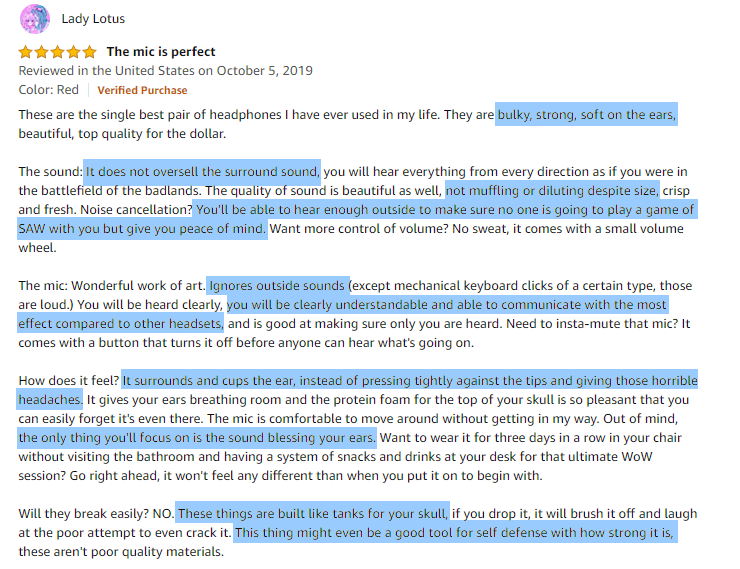
Use “you” while building a narrative that includes real words that your prospects and clients are using. You can find these in comments, social media messages, product reviews, industry communities, and anywhere where people can voice their thoughts.
Here’s an Amazon review with a couple of highlighted words that could be integrated into your copy:
Keeping key ideas clear
Some articles look like this:

Others like this:

While the second version does make it easier for people to follow through and stay hooked, both are fine as long as you keep one idea/paragraph. So each paragraph should look something like this:
A sentence to explain a problem or introduce a new idea. A second sentence to add in the details you couldn’t fit in the first sentences. Even more details. More details. Yet, another sentence for details and opinions.
Structure above all else
If you’ve researched a topic before you’ve noticed not all articles you’ve found had a clear structure. For one, having no structure makes it difficult for readers to maintain their focus. As a writer, you’ll struggle to write that piece of content in a good manner with relations between what you wrote at the beginning and what you’re mentioning throughout its body.
There are two things to fix here.
First, try building your own checklist with the most important steps you need to cover and follow that list so you don’t give up on an article halfway through.
Here’s an example with my own checklist:
- I start with an idea.
- Then I do my own research.
- I’ll write a brief outline with some of the ideas I want to cover.
- I take all ideas and build a structure with appropriate subheadings.
- I get to actually writing something.
- Days later, I make small edits here and there, I read the article again to proofread it, and the most important part, I rewrite.
- Finally, I add the final draft into WordPress.
- I edit headings, text boxes, images, and other formats before I have one last look at the preview and hit that Publish button.
While this focuses on the actual writing process, you need to also keep your ARTICLE structured by setting an outline and relevant subheadings.
Every article is different when it comes to what headings it needs. The typical Introduction – Heading – Heading – Conclusion format doesn’t work anymore. Pretty sure it never did.
The SERP analysis I mentioned will tell you roughly how your structure should look like. Your final article should include the common headings of the other articles as well as have a couple of unique headings and subheadings if possible.
Let’s see this in practice.
Imagine you’re creating an outline for an article that should rank for “conversion rate optimization”, after an elaborate analysis of the other results, the structure should look like:
- Introduction
- What Is Conversion Rate Optimization?
- What Is A Conversion Rate?
- How To Calculate Conversion Rate
- The Benefits Of CRO
- Top Conversion Rate Optimization Tips/Strategies
- How To Tell If CRO Is Right For Your Business
- Where To Get Started
Offer real value
As a rule, everything you write should offer at least one key takeaway to all readers.
Pose an intriguing question that would make them think or even participate in a discussion.
Make them feel good, teach, entertain, be an inspiration.
State the benefit in the headline if you want to but stick to what you promised.
Make sure you cover benefits at all times and write facts that are useful. Nobody wants to waste even a minute reading an article and not getting any reward from it.
People demand information here and now. If you want people to read your content, you’re asking for their time and in return for it you have to give something back.
Don’t claim, prove it!
The majority of the articles you see out there have one thing in common: they claim to give you the best tips but end up repeating everything that’s been said before. The web is already oversaturated with the same info being repeated over and over again. So people are often confused, not knowing where to turn to for real insights.
One way of ensuring that the content you publish stands out is to avoid repeating common tips. Here’s a formula to memorize and turn to whenever providing help:
Problem + Solution + Detailed examples, case studies, and data to back it all up
To avoid going down the wrong path, get to the point straight from the beginning. Got something to announce? Say it from the introduction. Have a unique opinion? State it right away. Put the information you want people to remember as early on as possible.
With articles that focus on providing solutions, writers tend to have two approaches: either mention the solution at the beginning as a TL;DR section or have readers gradually discover the answers towards the end.
Knowing when too many details aren’t necessary
We’re all aware that Google and even some people prefer long-form content. Simply because this makes it easy for us to get all the information we need from a single source.
When half of a 6,000-word article is fluff though, seemingly good articles will fail to deliver. People have different perceptions of what “useless content” is. So what’s considered fluff?
- Sentences that repeat what you’ve already said in a past phrase or paragraph
- General statements everyone is already familiar with – Such as the “The web is already oversaturated with the same info being repeated over and over again.” sentence I intentionally added in the previous section.
- Words that add meaningful details to a sentence
- Too much emphasis on metaphors, expressions, or slang words
- Unnecessary filler words like “that”, “really”, “also”, “like”, “actually”, and more – As a note from me, I’d add that these are only bad when overused. It’s okay to add them if you want to emphasize a feeling, word, or sentence.
If something seems complicated or you can’t find the right words, simplify it.
A single idea can be detailed in hundreds of thousands of words. You won’t have time to write everything and people prefer concise reads so keep only the details that matter for your message.
Does a small spelling mistake really matter?
No.
The majority of people skim online content and don’t even read half of it. All of those tiny writing and punctuation mistakes you missed during editing will most likely be ignored. Way too many people support the idea that spelling mistakes can ruin your brand’s image. 😑 It does only when it’s obvious and not a word among thousands of others.
But yes, content should be kept as clean and correct as possible.
For Google, of course.
While most algorithm influencers are guessed and tested by people instead of publicly presented, spelling and grammar issues could well be a part of them. Yet, it’s perfectly fine to publish content and fix any spelling blunders after.
A good headline
Headlines are so much more important than you can imagine.
They grab the attention of people making them choose your article among many other pieces of content.
A good way to make sure you get the perfect headline is to write down at least 10. You can share these with your team to see which one they’d click on.
There are a couple of ways in which you can use technology to come up with the perfect headline, including CoSchedule’s Headline Analyzer, the Emotional Marketing Value Headline Analyzer from the Advanced Marketing Institute, and Microsoft’s Text Analytics.
All of these solutions can give you hints on what you need to improve to choose a better headline. From adding real data directly into the headline to changing its tone and enticing people to read on.
Further reading: I Checked My Old Articles with a Headline Analyzer. And the Results Were Awful.
Review time is here!
Truth is writing is nothing until you’ve reviewed the article. First drafts are often bad. You can’t expect to finish writing an article and publish that version.
Now there is a difference between rewriting and proofreading but you have to focus on both of them during the review process.
Rewriting is when you take time to read the article as many times as necessary and change entire paragraphs, add new ideas, and even reorganize your structure.
Proofreading is a measure of making sure there are no typos, misspelled words, missing punctuation signs, and other small details.
I’ll be honest with you and tell you that the best way of reviewing your work accurately and as fairly as possible is having somebody else do this for you.
But how many times should you edit an article?
I need to tell you this and you won’t like it:
There is no end to rewriting an article.
You can publish it and then realize after a year that you don’t like it anymore and need to get back to it. There’s no way to avoid this.
Perfect writing doesn’t exist.
It all comes down to the reader’s perception and you cannot please everybody.
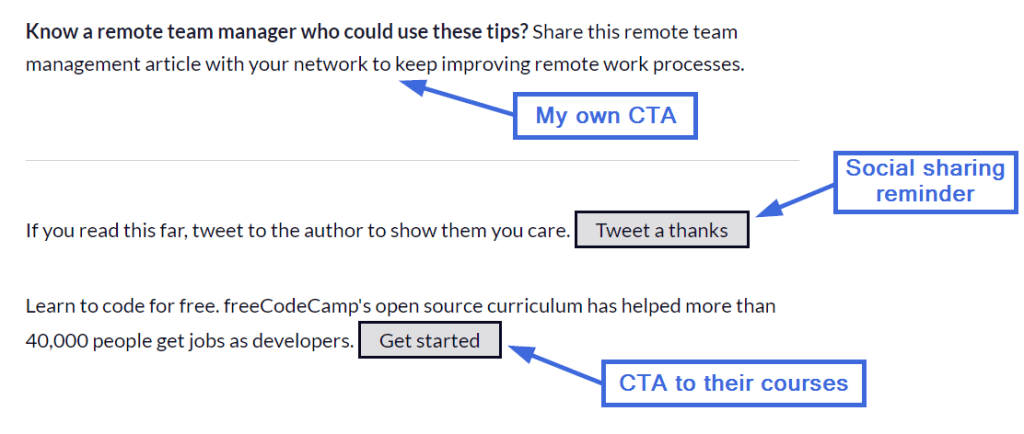
Adding a call to action
If you’re looking to write persuasive copy [and you probably are], you want to tell readers exactly what’s expected of them at the end of the article. This Brafton study found out that adding a CTA to your usual article template can increase revenue by as much as 83% in one month.
The call to action you use can be obvious or more subtle, depending on whether you want a share or you need people to complete an action your strategy depends on, like filling in a survey, signing up for your beta, or sending in a contribution for your next article.
You can opt to have a default CTA on your blog either in the form of a huge banner to click on or something like freeCodeCamp uses to get people to share their content. Here’s a breakdown of one of my posts on their website:
Is fast writing a good solution?
All I can say when it comes to writing is:
Avoid rushing.
The more time you dedicate to an article and to each word in particular the greater the results will be.
Take the time to improve yourself and become a better writer.
However, speed when it comes to writing does not refer to being as fast as possible. It’s all about learning the right habits and mindset that will allow you to finish writing in a short time.
So here are some tips you can try to manage and put more words and ideas into the same time frame you would normally write in:
- Start your day writing to put down as many ideas as possible.
- Make content your first pick whenever you have to choose between writing an article or going out to do something else.
- If you’re feeling tired or stuck it’s best to stop writing altogether and get back to writing the next day instead of wasting time thinking about ideas which are not that good or worrying about how you’re not going to reach your deadline.
It’s really about writing less but more often so you can learn to create a habit out of content writing for your website.
You’ve now got exactly two choices, both of which will work. You can either write content fast but edit it later or take your time and write one page at a time.
Content writers tend to give up sometimes after a few tries if they see the results are not as good as expected. I’m sure you hear this all the time but it’s true: content takes time. The more you focus and work on a thing, the better results you’ll get.
Telling if what you’re about to publish is more than “good enough”
Answer this:
Would you read the full article yourself?
You don’t want to publish more “dump” content for the sake of having something on your blog. Nobody’s going to read it and it won’t bring in any sales.
Always aim to provide a unique fact, insights, or opinion to your readers.
Craft your entire article around unique research you conducted, a survey, or a case study. Reach out to other people to share their own feedback and thoughts or go out of your way to share your own, real opinions on a topic.
Be mindful though. Meeting your SEO purposes with unique content can be more difficult. If you don’t have a pre-existing following, people won’t find your content as easily.
So here are 3 of the things top writers do:
- Analyze the SERP, match the reader’s intent, and bring their own one-of-a-kind take for a single section of the article. Mention this distinctive aspect in the headline, first words of the article, or first heading so people won’t roll their eyes thinking it’s yet another “ultimate guide” they’re going to read.
- Promote like crazy. I mean hours, days, weeks, and months you need to spend pitching, looking for backlinks, guest posting, and staying ultra-active on social media. ALL of this for ONE piece of content.

Get a little help from influencers. This doesn’t apply to all content types and things can get tricky because results are usually temporary. What you do is either mention top professionals in your field or reach out to them for a quote or survey contribution and ask them to share and talk about your article in return.
How long does it take to see results
Anywhere from 10 minutes to 2-3 years.
It’s a mix of your current blog authority, promotion capabilities, and volume/difficulty of the keyword you chose.
But “results” can mean different things.
Do you want to rank in the top 10 search results? Are you looking for new leads and conversions? Want more engagement? These all depend on the content type and format you’ve opted for as well.
All companies have different growth patterns. So you can’t expect to see the effects of your content writing efforts in 2 months because your competitor or partner has.
Better said, every company has a varied set of determinants. If your DA is still low, you’re somehow stuck with a high spam score, or you don’t have anything to promote yet, better fix those issues first.
Do these content writing techniques always work?
80% of the time.
What… What about the rest? 🙀
Frankly, you can do all the research and optimization in the world if one week later a competitor comes in to target the same keyword.
The SERP environment is forever changing. There are no miracles when it comes to content. Just lots of analysis and time.
This is the secret to good content: The more time and research you’re willing to dedicate to a single article, the better the results.
How to choose the right content writer for your business
It’s tough. Won’t lie.
You can take a look at someone’s content writing services portfolio and then they deliver something different. So my best tip is to commit to collaborating with a writer for the long run. This gives them enough time to understand your goals, learn more on everything you’re looking to promote, and craft a strategy that will match your business.
To find your next content ninja, you’ve first got the outbound option of going straight to the writers you’d love to work with. Maybe you saw an article whose style you’d like for your own blog or like the way a certain writer thinks.
Otherwise, type in “industry + writer” into Twitter or LinkedIn to find a couple of writers, get in contact with them, and see if they’re a right fit for the topics you need help with and budget.
Check industry-relevant websites like Content Marketing Institute or top-tier outlets like Entrepreneur or Forbes to see who’s posting on subjects you want to cover. Or, ask around for referrals. Always works like a charm and you get inside facts into how a writer works.
If you’re looking for more technical content or topics from smaller niches where most writers aren’t active, try posting an ad on ProBlogger or BloggingPro. Be specific about your needs from the heading so experts in narrower niches like Drupal, metal detecting, or community protection can spot the ad.
Some aspects to pay attention to, depending on where your priorities lie, include:
- If the writer has experience with the topics you need content on
- A writer’s past portfolio to find out any of the secondary topics you might need help with in the future
- The writer’s style of writing and tone
- If the writer writes for any reputable websites
- Recommendations from other clients if possible
- What the rate is [you’ll get exactly what you pay for]
From here on, it’s up to you to discuss important aspects like:
- How many words can you write for us/month?
- What is your rate?
- How long does it take you to deliver one article?
- Do you include research, images, quotes, and other extra work in your rates?
- Do you prefer ghostwriting or getting credit for the piece?
+ Anything that’s of top importance to you. You might want someone who’s written for a competitor and has hands-on experience in your niche or you’re looking for a writer with a similar tone to that of your brand.
Collaborations start with a test article. To judge this piece, you might want to have an editorial style guide in place. Just to keep things consistent. If you’ve chosen the right writer based on a solid portfolio, this article should meet your expectations.
FUN FACT
Small brands usually work with one writer while the rest of the team or marketing manager can also write from time to time. Medium companies with 40+ regular employees are already looking at 3-4 freelance writers who can provide a steady stream of content.
Real examples of exceptional content writing
A detailed look at a couple of top-performing articles and why they excel.
A Small Business Owner’s Guide to SEO
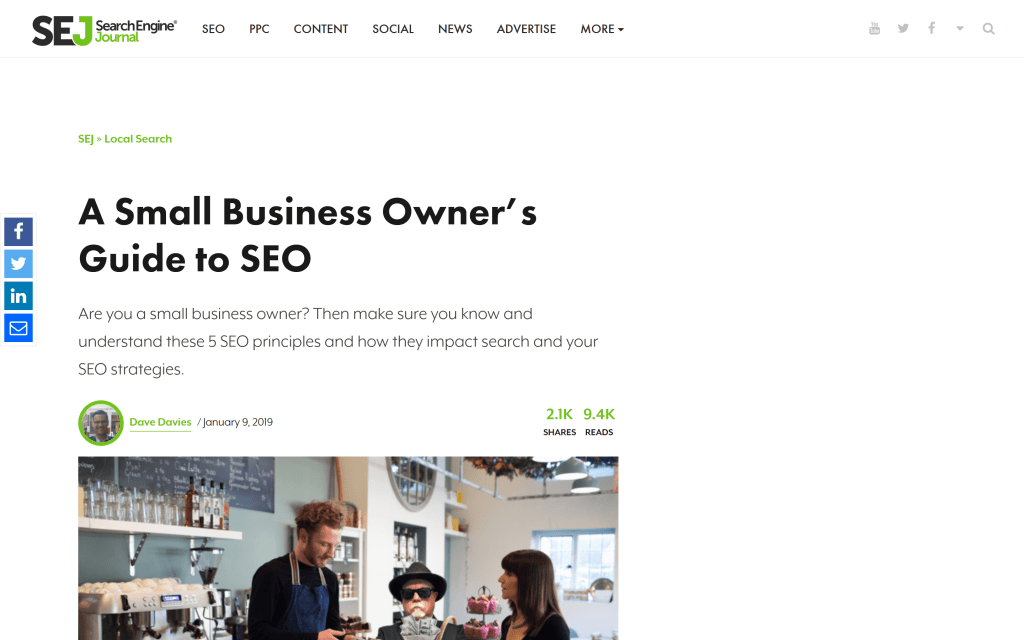
As you’ll notice here and in most examples, many of these articles excel first and foremost thanks to their genius topics. We’re talking about ideas that people truly need to find out more about.
This article on the Search Engine Journal blog is a perfect representation of what good structure can do for you. All paragraphs are short, with lots of white space, and simple wording.
The author uses a friendly tone that keeps people reading. Add in the narrative-like flow of the article to create more engagement and you’ve got yourself a great example of a listicle that doesn’t make you close the tab.
Video Marketing: The Definitive Guide
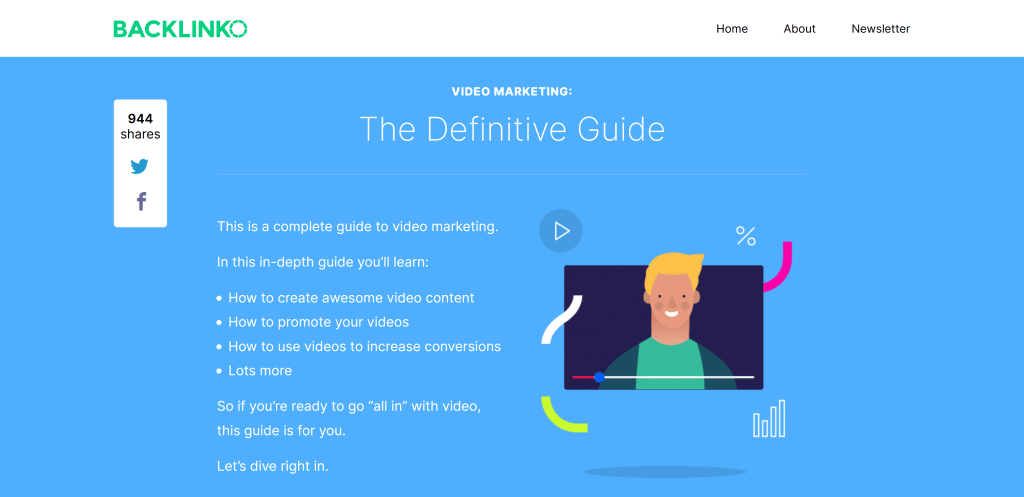
Any article from Brian Dean can become a standard model for your future long-form content. What does he get right? Well, besides everything, here are some specifics:
- On-point introductions
- Table of contents to make it easy for people to skip to the section they’re interested in
- Visual images and videos scattered throughout the entire article
- Short paragraphs and sentences that use the reader’s tone
- Several statements supported by data or images
- Researched and SEO-friendly structure
- Top-level keyword optimization
- CTAs in the conclusion to get people talking [he also takes the time to answer all comments]
Fairly speaking, if you’ll do exactly what he does, there’s no way to fail with your content writing attempts.
The Ultimate Guide to Video Marketing
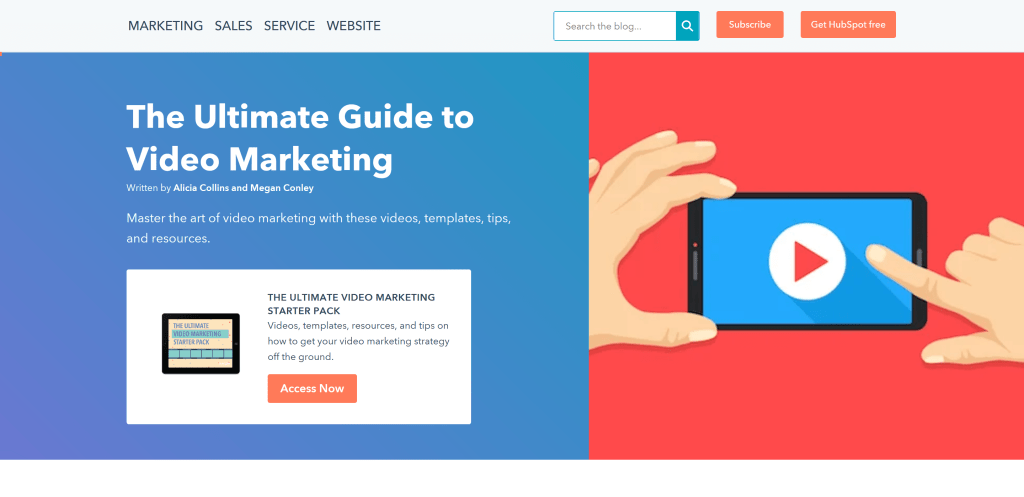
This is HubSpot’s approach to the topic above so you can compare it to the previous article, both being great examples of how you can tackle a topic in terms of structure, wording, and ideas.
The articles are in many ways similar except for the style of the author which is visible in longer paragraphs, a more serious tone [have a look at this example to see what a usual neutral writing tone looks like].
How Fattmerchant Lowered Their Cost-Per-Lead With Biteable

This wouldn’t be a legit list with a case study. When talking about their product, many startups turn to their customers to build case studies that can showcase how they’ve helped someone else. A good alternative to simple product update posts may I say.
The key thing to keep in mind if you’re thinking of writing the case study yourself is that you don’t need to write everything. The best case studies focus on concise info about the client, problems they faced, a solution, and results. Add on images, highlighted quotes and stats, and any extra but brief tips or calls-to-action and you’ve got yourself a succint case study that people will have time to look over.
Send Better Email: A Step-By-Step Guide To Improving Your Email Deliverability And Open Rates

If you don’t have too much time to put together an article, turn to the Intercom blog for some samples of brief articles that your audience will love. The content there proves how anyone in your team, regardless of writing experience, can create worthwhile pieces.
The number one thing this specific article gets right is delivering to the headline’s promise. Second to that is the lack of fluff. Every paragraph brings in a new idea and you’ll get real tips from the author who’s an expert in her field even though she’s not officially a writer. For this reason, she chose to speak only on the matters that fall under her expertise. This will only improve your blog’s thought leadership and readers’ trust in you and your sources.
She even added a call-to-action at the end and kept the structure clean without going into unnecessary details. 👏👏👏 Good stuff!
Here’s What You Should (And Shouldn’t) Do When Giving Formal Feedback
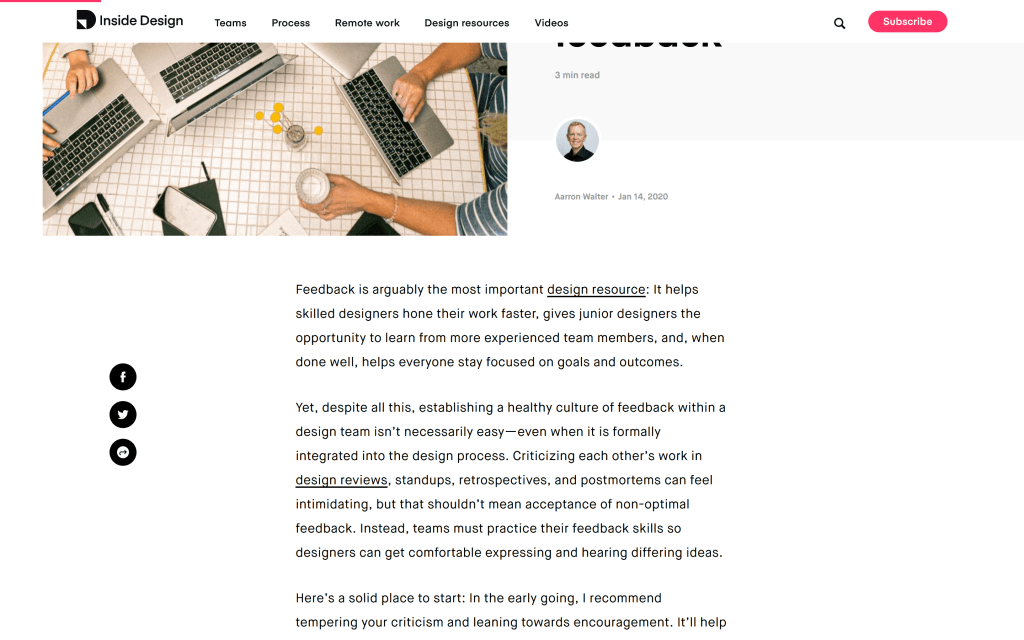
Another similar example from InVision that proves how your team members can bring in real value to your blog as long as you’ve got a solid content calendar in place.
To keep your content consistent in terms of tone and structure, have either your marketing manager or a content strategist go over the posts before publishing them.
How to Create A Remote Work Routine That Works
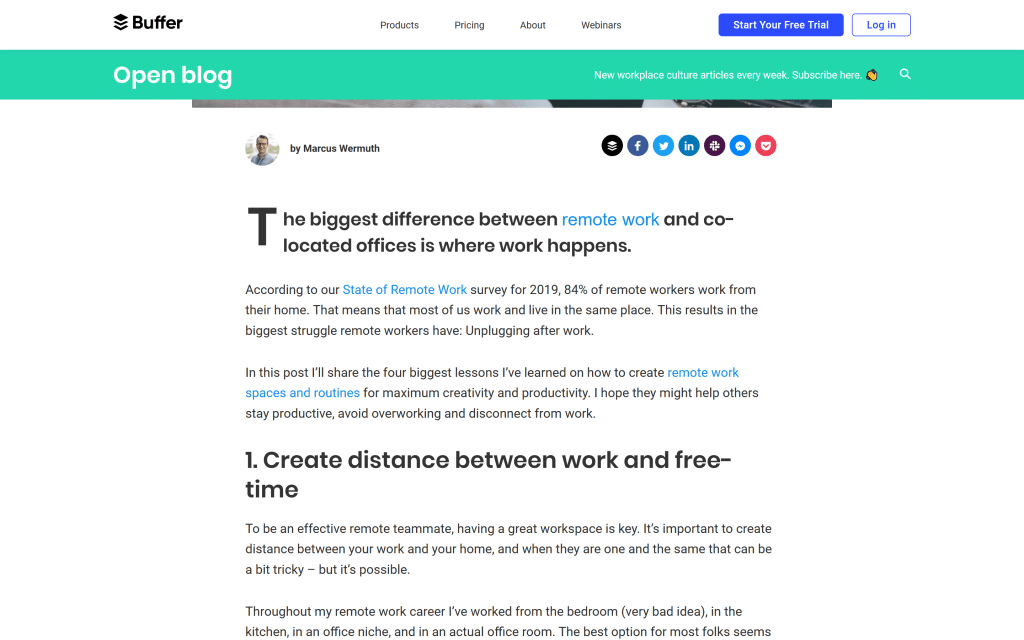
The Buffer blog can offer you some great ideas of how you can implement diverse content types, topics, and even make use of every single team member’s expertise. Yes, including software engineers.
While the content marketing manager’s touch is obvious through the internal links and CTAs a non-marketer probably wouldn’t add, it’s the expertise of the author that shines through. Frankly put, if you had a content professional write about the schedule of a software developer, it wouldn’t come off as authentic.
Having people write about their own experience is not only more credible, but also valuable regardless of any content writing knowledge they might lack. I mean, a post like this got almost 200 shares. That is a lot, not viral, but a good number to aim for.
Getting Started with Your CoSchedule Marketing Calendar
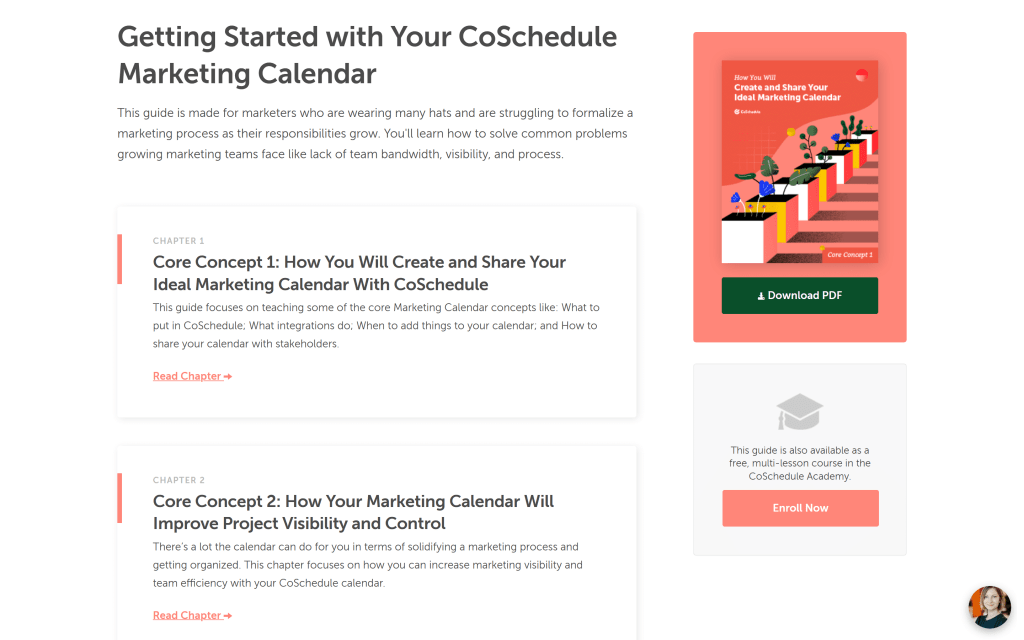
This piece proves how content can come in different formats. A guide for instance can be on one page or have multiple chapters, each on a distinct page like this example.
The CoSchedule team has put their best foot forward to promote their product in an educational way. Every chapter aims to be educational instead of promotional by giving out real tips which can be implemented through their tool. As you’ll notice, the text is kept simple with clear instructions and supporting images. Do note that here visuals are a complementary part of the guide.
How to Create SEO-Friendly URLs (Step-by-Step)
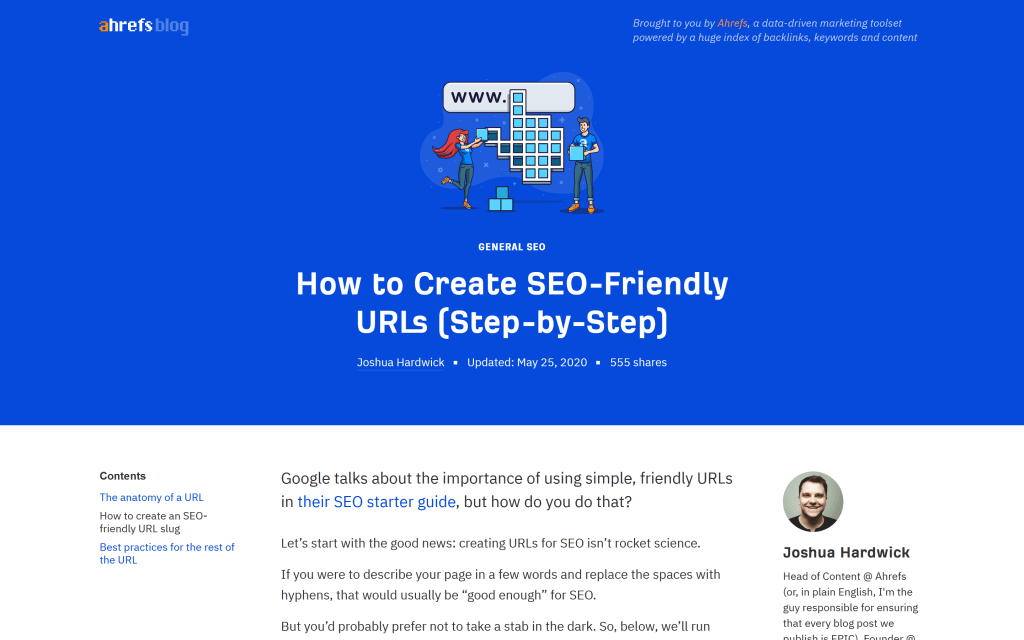
Ahrefs has that one blog I always recommend when people ask me for a brand that nails their content strategy. They’re a perfect example of how you can keep everything you write connected to your product yet still informative. So their articles don’t even come off as promotional.
Their style is similar to Brian Dean’s, with every article including all possible elements you could use to keep the article engaging and not a bunch of words under boring headings. Videos, GIFs, embedded content, tip boxes, perfect internal linking, highlights, you name it.
How We Made Our All-hands Meeting Asynchronous

If you need some more ideas on incorporating your product into your content, look no further than Loom. You probably already use your product, so why not tell others how you do it?
The article takes a step-by-step approach to actually explain the topic first. Then, they show the problems you could experience and give you an up-close look at how they fixed those problems using their own tool. 😍 A complete article.
5 Things You Can Do With 5 Hours On Pluralsight

There are hundreds of examples of good product placement. This one in particular is a clever piece that makes use of anyone’s top concerns: not having enough time and wanting to make the most out of every second.
The article then moves on to deliver to what they promised in the headline which led to a whopping 355 engagement with the post. A lot considering this is a product-oriented post. Explainable once you remember that Pluralsight is in fact an education provider.
9 Creative Popup Ideas to Make More Money for Your Ecommerce Store

Unbounce has some of the best lists you’ll see on the web. Don’t let the title fool you into thinking this is another simple listicle. For each list item, there are roughly 300+ words to explain a choice and offer tips without any fluff.
Most of their lists though rank for another reason: they are not simple lists. This example, for instance, includes an extra What Makes an Effective Popup Promotion? heading to provide the theoretical aspects for anyone who’s looking for more than examples. Talk about catering to everyone’s needs.
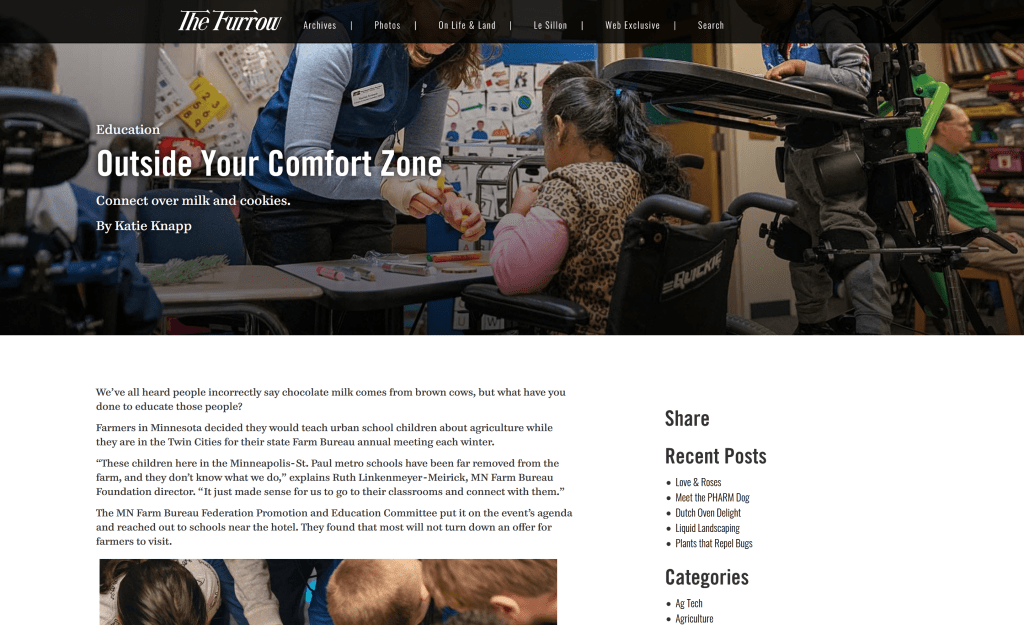
Yes, content works for all industries. John Deere’s The Furrow blog stands as proof. But they do take a different approach to match their brand’s needs. They turn to storytelling.
Every article is an account of an inspiring story, complete with quotes and a format that makes people read the content like they would check their daily news. I’m sure you or your clients all have a good story to share, so why not make use of that?
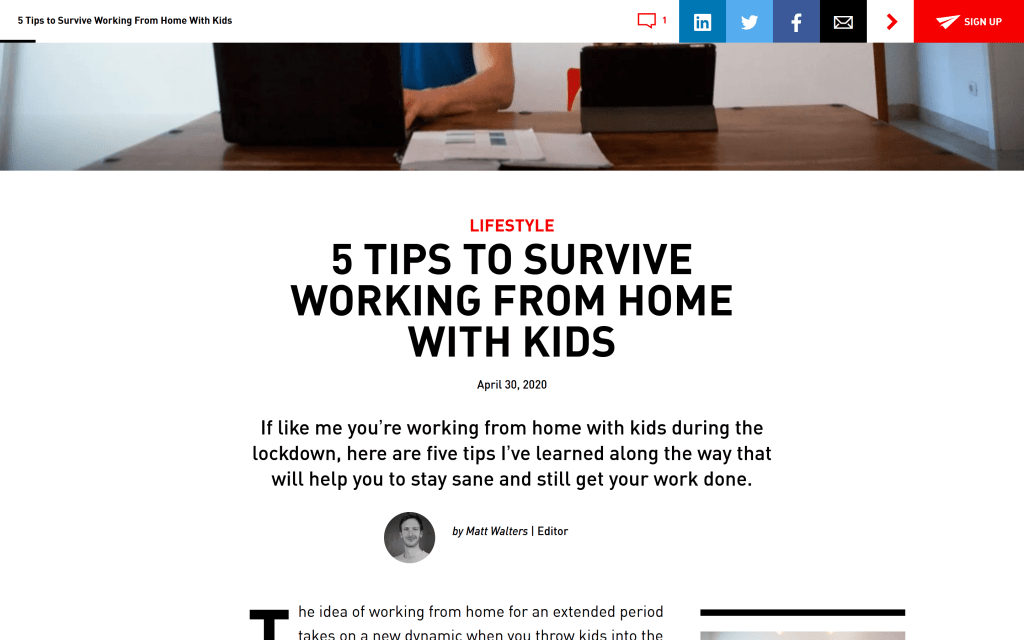
5 Tips To Survive Working From Home With Kids
YOU NEED TO SEE THIS.
Another blog that’s created around storytelling is adidas GamePlan A.
Look at the post above. They took what would otherwise be a not-so-special list and turned it into a real story that provides real insights into the author’s life. Bonus points for actually taking the time to write something different. And cookie points for tackling topics people want to read more on instead of just sportswear.
As an extra, take a look at the way the article is laid out through various visual elements which scream “Read me!”. Proof of how much a strong focus on readability can improve a post.
Content Curation On Social Demands More Than A Shared Link
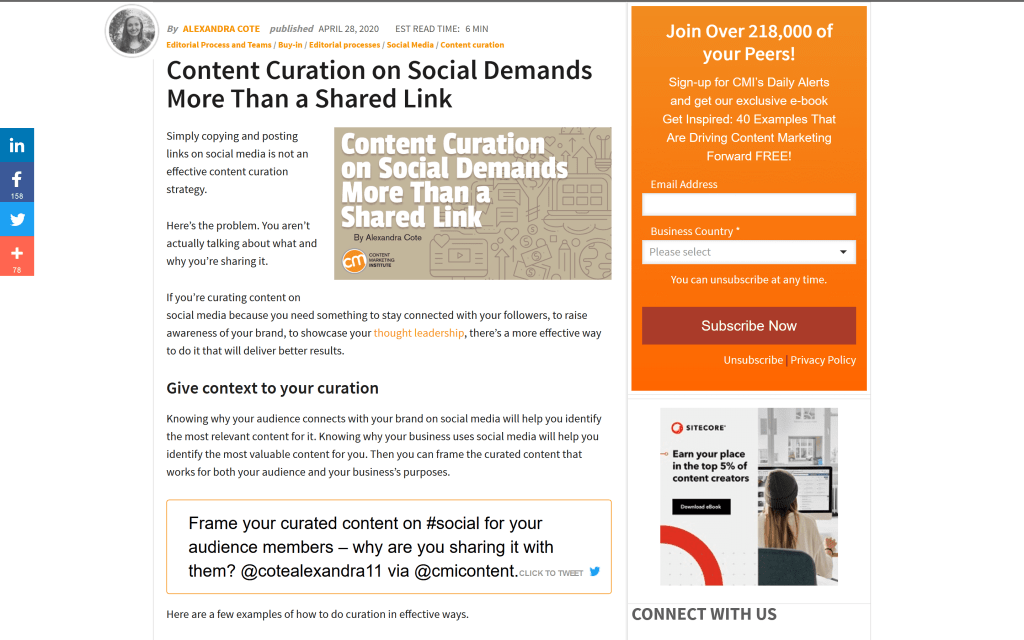
Disclaimer: I wrote this so I sure have close insights on it.
The idea behind this post was to do my own detailed research on what good link sharing looks like on social media. The reasons why this was widely shared are these: the problem presented is a common one AND it hasn’t been tackled in such detail before.
The article is riddled with hands-on examples of content shares. This shows readers that the writer has done the research in their place and provides proof of their statements. I didn’t leave the article there but went one step further to show what the best tools for content curation would be.
The CMI team came in to add the useful Click to Tweet snippets which make it easy for people to share snippets from the article. And let me tell you, they sure work. You’ll notice small “HANDPICKED RELATED CONTENT” sections throughout the article which are meant to keep readers on the website where they can find other related content.
We’ve Tried 5 Skype Alternatives and Here’s Our Honest Team’s Feedback
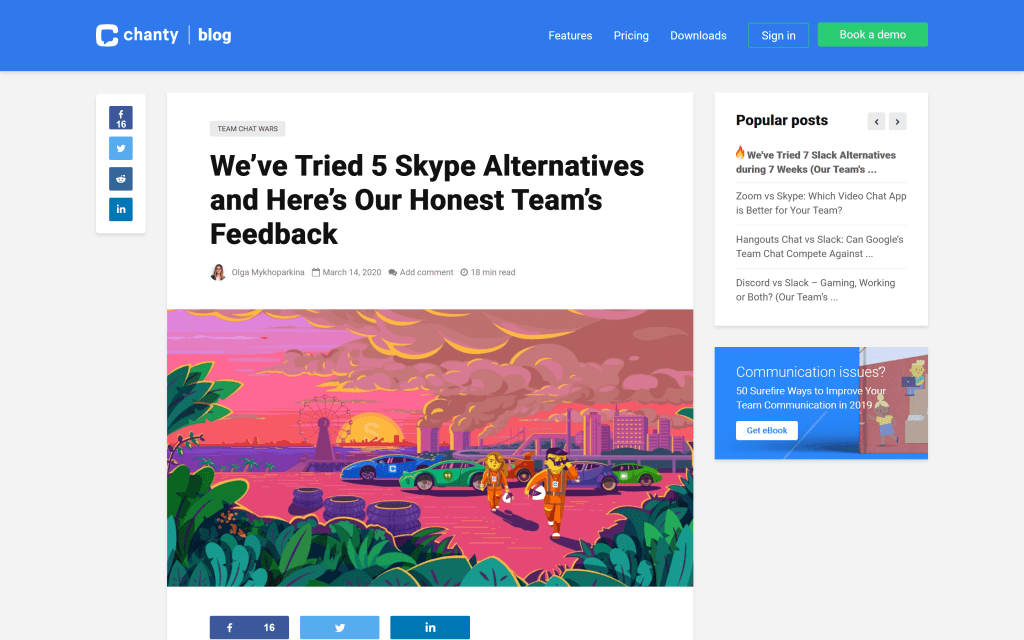
Here’s an example of a startup that keeps impressing with their consistency in publishing regular content that keeps up with the trends.
I came across this article a while ago and was pleasantly surprised to see a different approach to your typical tool comparisons. They’re not just giving you a general review or telling you that the author has tested these apps. They got their whole team on board to share their honest opinions. So if you’re planning on writing a tool list, take note from here.
The Ultimate Startup Failure Rate Report
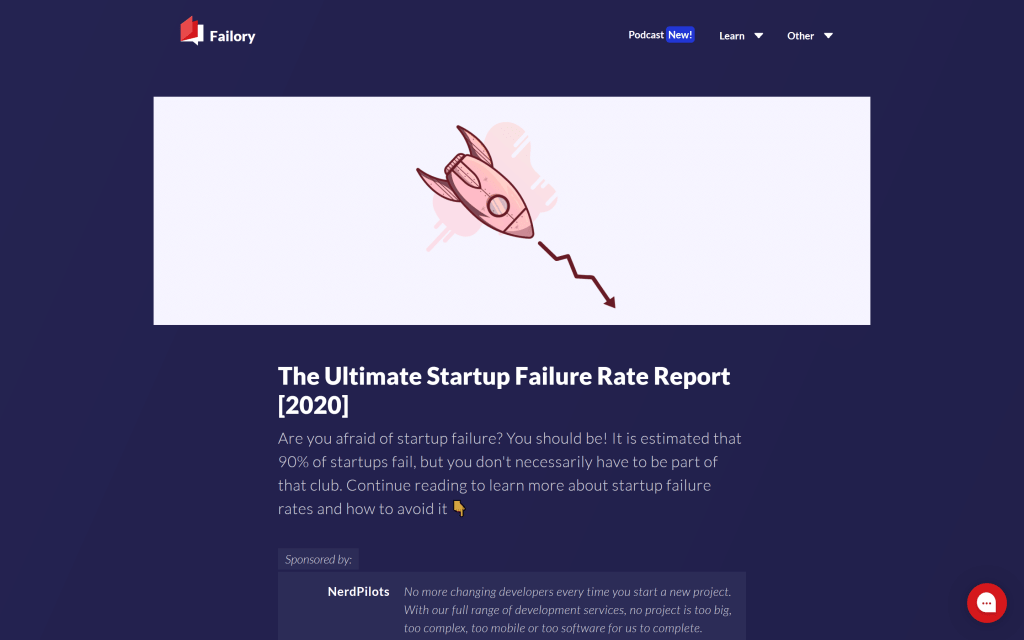
Had to mention this report so you can see how anything can be turned into a report that’s worth sharing. And just so you can understand why reports such as this one provide traction: they already have 187 links.
That’s 187 upvotes that can bring in more traffic from all kinds of sources. This is a huge helping hand if you want to test out new networks and promotion channels with minimal efforts.
Back to you now
I’m hoping this has shown you that writing content is really all about taking a systematic approach. And, yes, anyone can do it. So whether you’re writing articles, a book, or short social media posts, go over the list above to polish your skills and, in essence, know what to pay extra care to.
Don’t forget to share this guide to content writing with anyone who’s either struggling to put together their next article or needs a small push to regain their motivation.
So, Alexandra, why are you letting these secrets out? For one, paying attention to everything above is super time-consuming when writing. That’s exactly why companies reach out to content professionals to avoid spending months on what would take no more than 2 weeks for someone who does this for a living.
The second reason is that content is so much more than just writing. Plus, every brand will need a different strategy. But more on that next time.😁
Feel free to reach out to me via the contact form for any questions or inquiries related to your content strategy.
Until next time, stay curious! 🦄
Alexandra Cote

Further reading:
What Makes Company Blogs Great – 100+ Business Blog Homepages Analyzed
B2B and B2C Case Studies – Who Does Them Right [Tips Included]
Content Marketing – The Anatomy of Successful Content
The illustrations in this guide were create by the wonderful Aurielaki.

 Alexandra Cote 🚀